Any manufacturer of daily chemical products planning to expand its production scale will first face a critical decision: Should it opt for a fully automatic or a semi-automatic tube filling machine?
Today, the manufacturing sector worldwide faces the same dilemma: Labor costs keep rising. Product SKUs keep growing. Customers want faster delivery, fewer defects, and higher-quality packaging.
Choose the wrong machine, and you may face slow output, high labor costs, wasted product, and expensive upgrades within a year.
This guide breaks down the real differences between automatic and semi automatic tube filling machines.
- Which machine fits your production volume?
- How much output do you actually need?
- Which tube materials and products can each machine handle?
- Why are more factories replacing semi-automatic equipment?
- What features matter most in a modern tube filling line?
Automatic or Semi Automatic — Which Machine Fits Your Production Needs?
Production Speed, Labor, and Automation: The Real Difference
Automatic tube filling machine handles the full process by itself. It loads the tube, fills the product, seals the tail, prints the code, and ejects the finished tube.
Semi-Automatic tube filling machine still needs manual soft tube loading and unloading. The operator places the tube into the holder, starts the cycle, and removes the finished product.
Filling Speed Comparison
| Machine Type | Typical Speed | Best For Manufacturer Scale |
| Semi-Automatic Tube Filler | 10-35 tubes/min | Small factories, startups, trial production |
| Mid-Speed Automatic Tube Filler | 40-80 tubes/min | Growing OEM factories, medium production |
| Fully Automatic Tube Filler | 80-180 tubes/min | Large factories, contract manufacturers, export brands |
TRPACK Tips: If your factory runs a multi-shift system or achieves 20,000 tubes of daily production. We recommend opting for a fully automatic tube filler, as this would be a more practical choice.
Price Comparison
| Machine Type | Typical Price Range |
| Semi Automatic Tube Filler | USD 3,000-15,000 |
| Automatic Tube Filler | USD 20,000-120,000+ |
| Complete Tube Filling and Cartoning Line | USD 80,000-300,000+ |
TRPACK Tips: Low price does not always equate to low cost. While semi-automatic equipment may indeed entail lower initial acquisition costs, over time, high labor expenses and reduced operational efficiency often result in higher overall costs for the factory.
Labor Requirement Comparison
- A semi automatic tube filling machine often needs 2-4 operators. One person loads tubes. Another handles finished products. A third may inspect or pack them.
- A fully automatic tube filling machine often runs with only 1 operator. That single change can reduce labor cost by 50%-70%.
TRPACK Tips: Factories in the United States, Canada, Australia, Japan, and South Korea increasingly choose automatic tube filling machines because labor shortages make manual production difficult.
Which Soft Tube Packaging Equipment Best For Small Factories, OEMs, and Contract Manufacturers?
| Semi Automatic Tub Filling Machine Best For | Semi Automatic Tub Filling Machine Best For |
| Small Cosmetic Brands | OEM and ODM Factories |
| Start-up Skin Care Factories | Contract Manufacturers |
| Trial Production Level | Pharmaceutical Companies |
| Low-volume, Multi-SKU Manufacturing | Toothpaste and Oral Care Plants |
| Factories in Indonesia, Vietnam, Philippines, Africa, and other cost-sensitive markets | Large skincare and Cosmetic Factories |
| Export-oriented businesses with high output requirements |
What Products and Tube Types Can a Tube Filling Machine Handle?
Not all tube filling machines work with every product or tube material.
Before you request a quotation, you need to confirm three things:
- Filling Product Type.
- Tube Material.
- Tube Size and Filling volume.
TRPACK Tips: Cosmetic Paste Cream Tube Filling Machine and Toothpaste Tube Filling Machine remain the two highest-volume search categories in 2026.
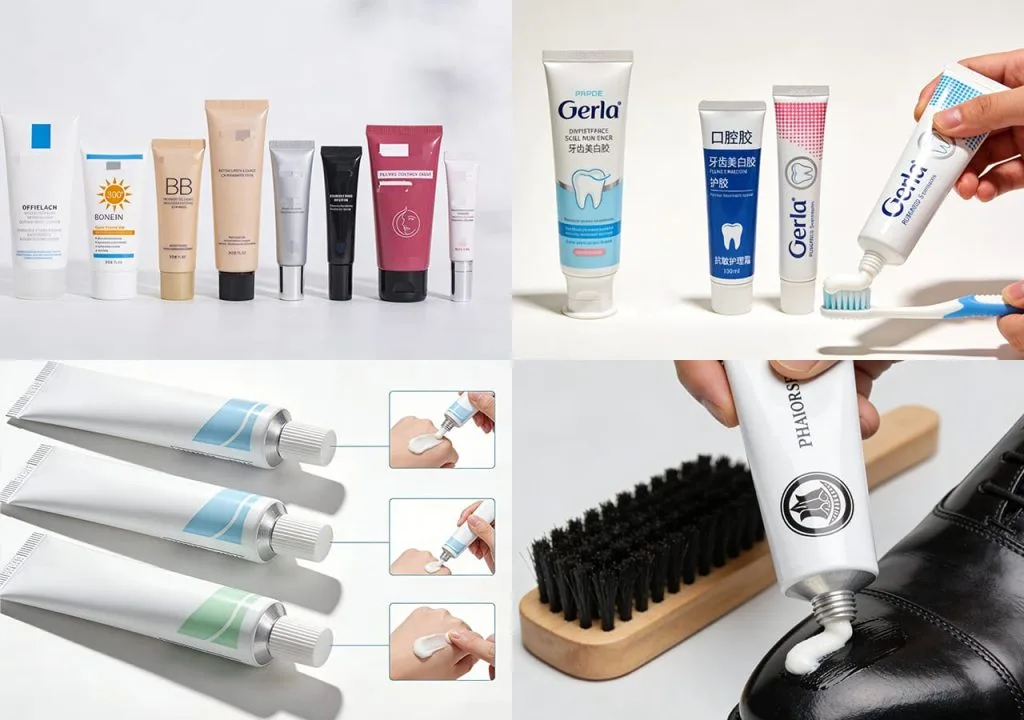
The Hottest Tube Filling Applications in 2026
1. Cosmetic Cream and Skincare Tube Filling
In recent years, the global skincare market has continued to grow. Increasing number of cosmetics factories require automated tube filling machines to fill the following products:
- Facial cleanser
- Sunscreen
- Hand cream
- BB cream
- Anti-aging cream
TRPACK Tips: OEM cosmetic factories especially prefer automatic tube filling and sealing machines with fast changeovers. They often run many different SKUs every day.
2. Toothpaste and Oral Care Tube Filling
Toothpaste production needs higher speed and higher sealing consistency.
Toothpaste tube filling machine usually includes:
- Servo filling system
- Automatic tube orientation
- Batch coding system
- High-speed sealing
TRPACK Tips: Most toothpaste factories choose fully automatic machines with output above 100 tubes per minute.
3. Pharmaceutical Ointment and Gel Tube Filling
Pharmaceutical manufacturers care most about:
- GMP compliance
- High filling accuracy
- Stainless steel 316L contact parts
- Easy cleaning
- Validation documents
TRPACK Tips: For this reason, many pharmaceutical companies use aluminum tube filling machines with cleanroom-compatible designs.
4. Pet Care, Household Cleaning, Automotive Care, and Adhesive Products
Tube packaging is growing fast outside cosmetics.
More factories now use tube filling machines for:
- Pet skin cream
- Household cleaning gel
- Car scratch repair cream
- Industrial adhesive
- Silicone sealant
These products often need stronger sealing systems and higher filling pressure.
Plastic Tube vs. Aluminum Tube vs. Laminated Tube
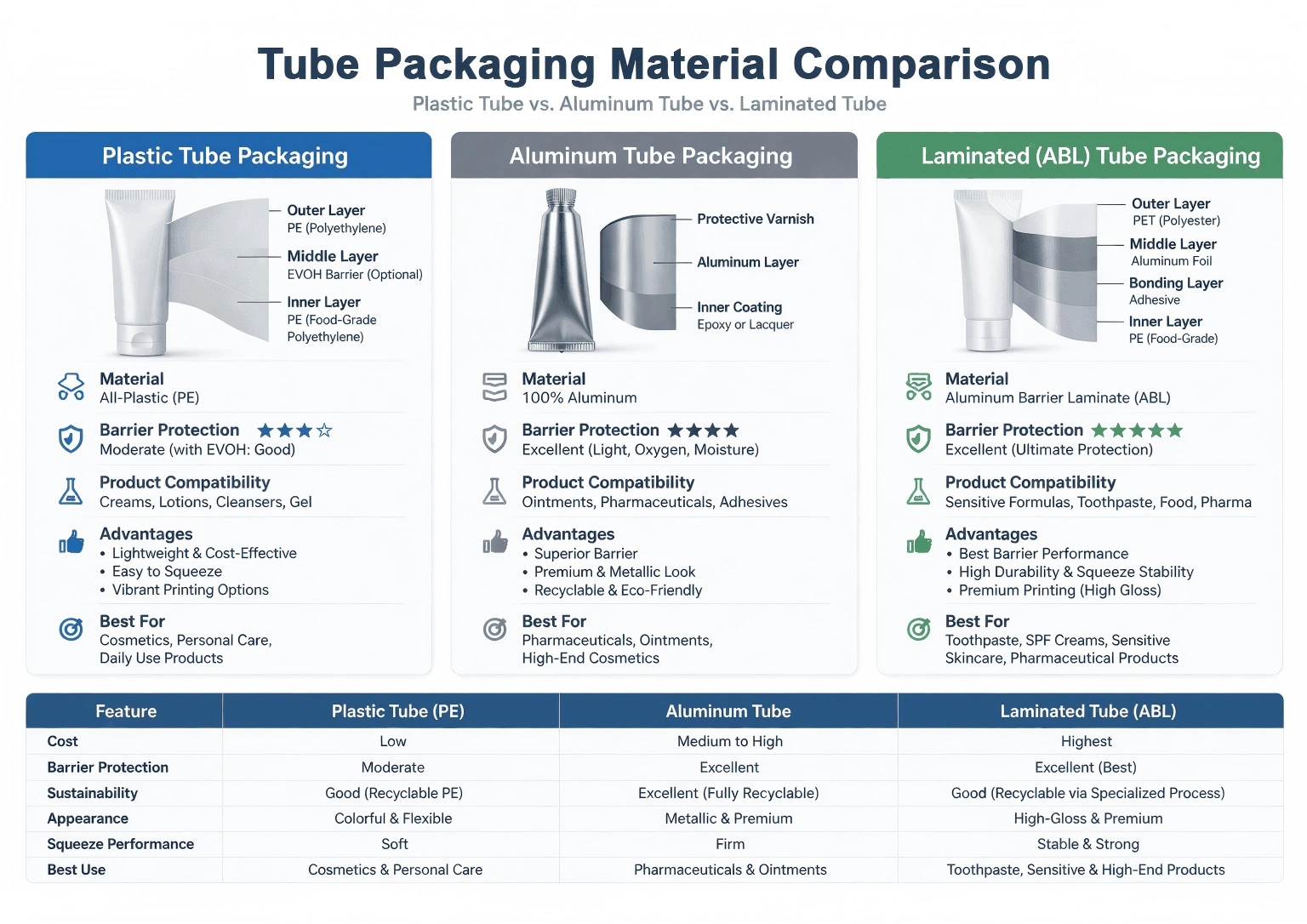
| Tube Material | Typical Applications | Recommended Machine |
| Plastic Tube | Cosmetics, toothpaste, skincare | Plastic Tube Filling Machine |
| Aluminum Tube | Ointment, Pharmaceutical cream, adhesive | Aluminum Tube Filling Machine |
| Laminated Tube | Premium cosmetics, toothpaste | Laminated Tube Filling Machine |
Many factory purchases now ask one important question:
Can one machine handle both plastic and aluminum tubes?
The answer is yes, but only if the machine includes interchangeable tooling and a quick changeover system.
How to Match Tube Diameter, Filling Volume, and Product Viscosity?
Before choosing a machine, prepare these specifications:
| Specification | Example |
| Tube Diameter | 16-60 mm |
| Tube Length | 50-250 mm |
| Filling Volume | 5-250 ml |
| Product Type | Cream, gel, paste, adhesive |
| Viscosity | Low, medium, high |
TRPACK Tips: High-viscosity products such as adhesives, toothpaste, paste products, or thick creams require a servo-driven filling system. That system gives more stable filling accuracy and prevents dripping.
Why Leading Daily Chemical Factories Are Replacing Semi Automatic Machines?
Rising Labor Cost and Labor Shortage
Labor costs have become one of the greatest challenges facing all manufacturing industries.
In North America, Australia, Japan, and South Korea, factories often struggle to recruit a sufficient number of production operators. A semi-automatic tube filling machine requires at least three workers to operate, whereas a fully automatic machine requires only one.
This shift could save the factory thousands of dollars in expenses every month. Isn’t that a tempting result?
Higher Output and More Stable Quality
Semi-automatic machines rely heavily on the operator’s personal experience and skills. Different workers may load tubes differently. That often creates:
- Uneven filling
- Weak sealing
- Misaligned printing
- More rejected products
A fully automatic tube filling machine solves those problems. It uses fixed programs, servo control, and automatic inspection.
As of 2025, numerous factories partnering with TRPACK reported that, after switching to fully automated tube-filling equipment, their production output increased by 20% to 30%, while their product defect rate was significantly reduced.
Why Contract Manufacturers Prefer Automatic Tube Filling Lines?
Contract manufacturers need speed and flexibility.
This week they may produce sunscreen. But next week they may switch to toothpaste or hand cream.
Smart automatic tube filling line supports:
- Pre-saved mold & Fast changeover.
- Multi-SKU production.
- Different tube sizes.
- Different product formulas.
That flexibility helps OEM factories accept more orders and increase profit.
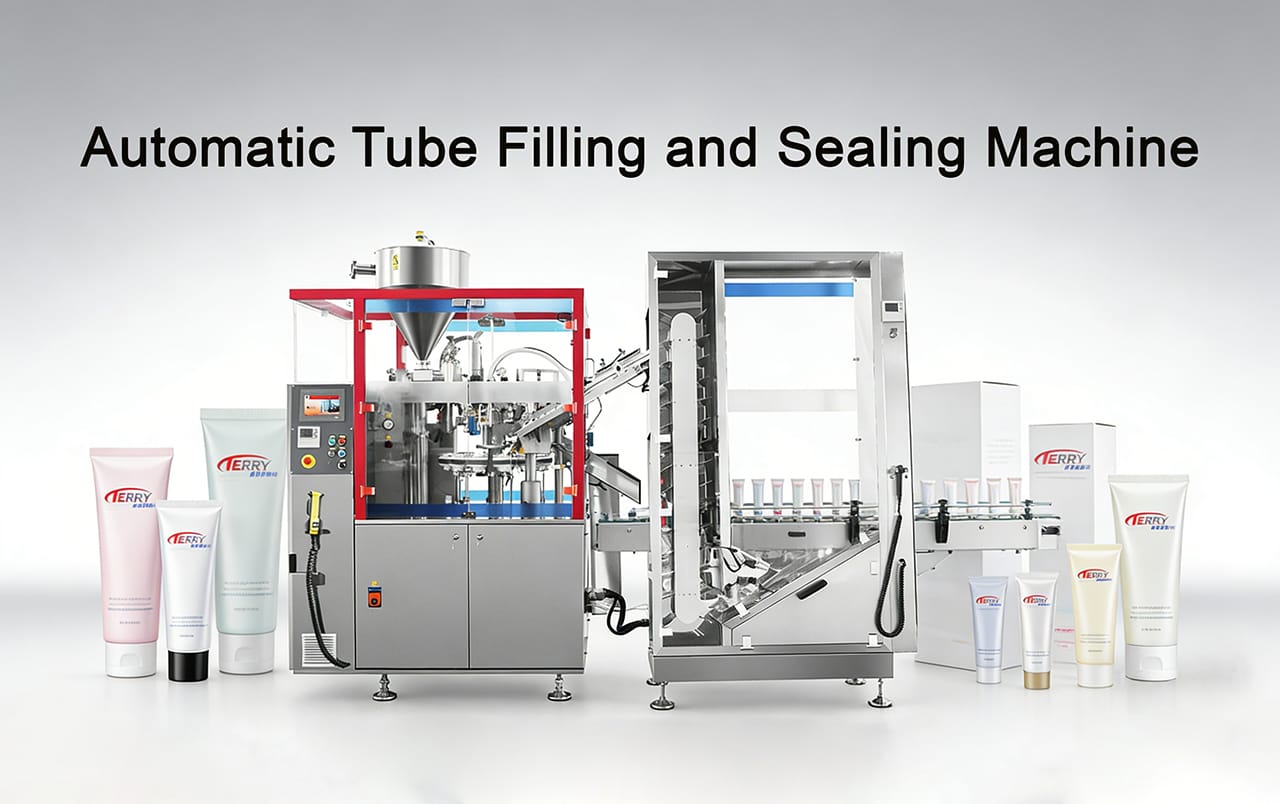
TRPACK Full Automatic Tube Filling and Sealing Machine
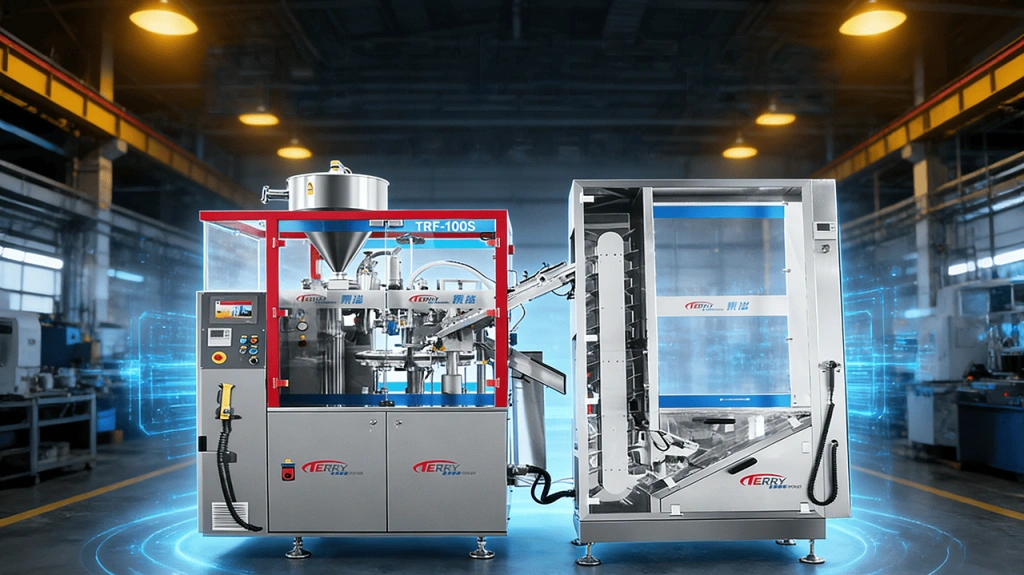
The TRPACK TRF-100 Fully Automatic Tube Filling and Sealing Machine is an integrated, intelligent packaging solution. Specifically developed and customized for sectors such as cosmetics, skincare, personal care, daily chemicals, and pharmaceuticals. It facilitates standardized sealing processes for both plastic and aluminum-plastic laminate tubes. The machine is broadly adaptable for the filling and sealing of pastes, creams, and various high-viscosity fluid materials.
The machine features a modular, compact design that maximizes space utilization. Powered by a programmable logic controller (PLC), it achieves automated closed-loop production, automating every stage of the process—from tube feeding, visual alignment, and volumetric filling to tube-tail trimming, sealing and compaction, and finished product output.
This equipment boasts a high level of safety protection and delivers consistently stable performance, characterized by precise positioning and minimal filling error. All surfaces in contact with the product are constructed from food- and pharmaceutical-grade 316 stainless steel, fully complying with GMP clean production standards to prevent contamination and ensure the safety and regulatory compliance of the manufactured products.
How to Build a Complete Tube Filling Packaging Line?
Squeezable Tube Filling Sealing Machine works best when connected to a complete packaging line.
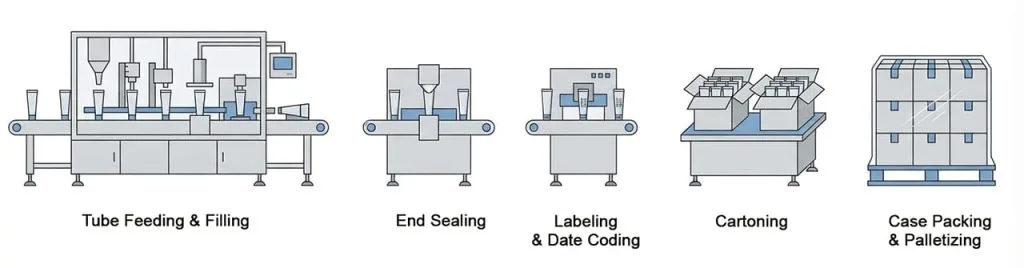
Step 1: Soft Tube Filling and Sealing
- Soft hose feeding
- Product filling
- End sealing
- Date coding
Step 2: Automatic Cartoning
After filling, the finished tubes move directly into an automatic cartoning machine.
- The tube
- Product leaflet
- Retail box
Step 3: Labeling and Date Coding
- Labeling machine
- Inkjet printer
- Laser date coder
Step 4: Case Packing and Palletizing
- Automatic case packer
- Carton sealer
- Robotic palletizer
That reduces manual handling and improves shipping efficiency.
Step 5: Smart Factory and Industry 4.0 Integration
Leading factories now connect their tube filling production line to MES or ERP systems.
- Remote monitoring
- Production tracking
- Predictive maintenance
- Real-time output reports
The Most Important Questions Manufacturers Should Ask Before Purchasing? (FAQ)
Q1: Is the tube filler CE, GMP, or FDA compliant?
A1: All of TRPACK’s tube filling and machines and related auxiliary equipment are certified by CE, FDA, and GMP.
Q2: What are the filling accuracy and tube-sealing quality?
A2: Filling accuracy is ≤ ±0.5%; end sealing pass rate is 99.8%.
Q3: Does one piece of equipment fill soft tubes of different specifications?
A3: Yes. A premium automatic tube filling machine can handle different tube diameters and volumes with change parts.
Filling range suitable for filling volumes of 2-400ml (2-20ml with 16mm cylinder diameter, 5-50ml with 25mm cylinder diameter, 10-100ml with 35mm cylinder diameter, 30-220ml with 52mm cylinder diameter, 50-400ml with 70mm cylinder diameter).
Q4: Can the machine fill both plastic and aluminum tubes simultaneously?
A4: Normal sure, if the machine includes interchangeable tooling.
Q5: How long does the changeover (switching) between different tube specifications take?
A5: The changeover time is approximately 20 minutes.
Q6: How much does a tube-filling machine cost?
A6: Please contact TRPACK’ professional solutions consultant. Simply provide details regarding your filling materials, container capacity, and production capacity requirements. We will provide you with a cost-effective quotation after an evaluation.
Q7: What is the status regarding spare parts supply, lead times, and after-sales service?
A7: Before you place an order, ask:
- Which spare parts come free
- How long delivery takes
- Whether overseas installation is available
- Whether remote video support is included
Q8: Can you provide a complete tube-filling production line?
A8: Yes. In addition to providing high-quality standalone tube-filling equipment, TRPACK can also offer you customized, complete intelligence tube packaging lines.
Q9: Can this machine be integrated with cartoning machines, labeling machines, and case packers?
A9: TRPACK is a professional manufacturer and supplier should provide a complete tube filling and cartoning line, not just a single machine.
That gives you better compatibility, easier installation, and faster production expansion.
Final Recommendation
Best choice depends on your product, tube type, daily output, labor cost, and future growth plan.
- If you are already run an OEM facility, contract manufacturing, or own an export brand, a fully automatic tube filling equipment will deliver a superior long-term return on investment.
- But If your factory produces in small batches and a variety of SKUs, a semi automated tube filling equipment may still be the ideal choice for getting started.
Before you request a quotation, prepare these five details:
- Product type
- Tube size and material
- Filling volume
- Target output per hour
- Required market certification
According this information, you can choose the right tube filling machine faster and avoid costly mistakes.