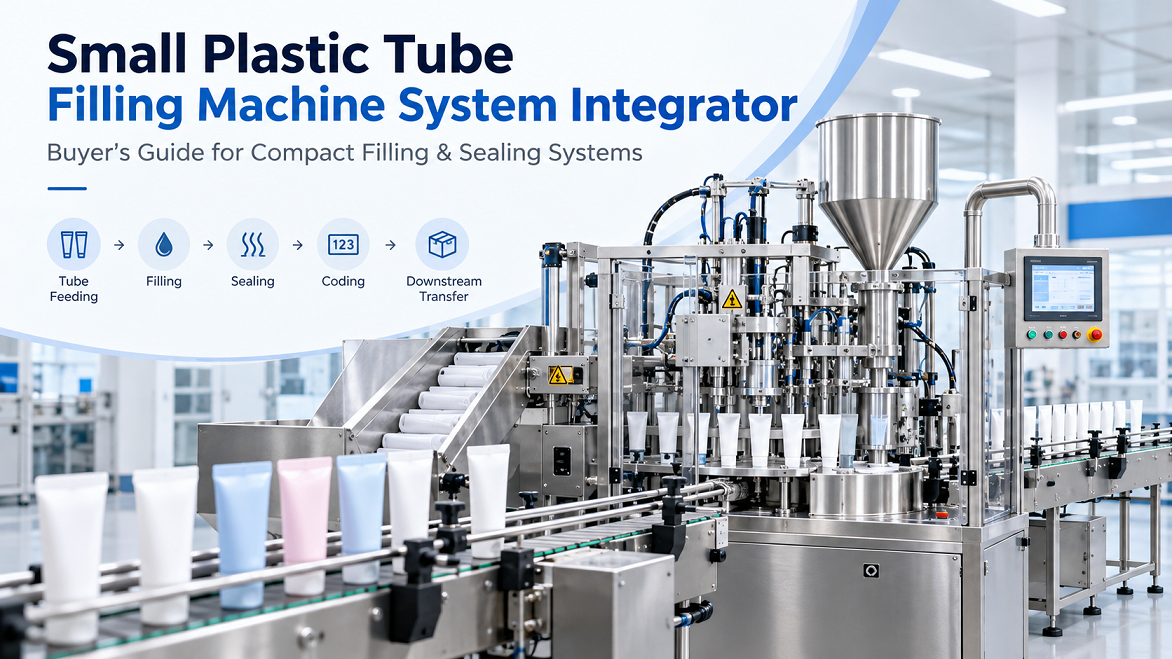
Selecting a small plastic tube filling machine involves more than finding equipment that fits your production floor. For manufacturers packaging creams, gels, ointments, and personal care products, the machine must also handle the intended tube materials, maintain consistent filling and sealing, and operate efficiently within the existing production process.
A standalone tube filling machine may be sufficient for a limited production operation. However, manufacturers planning to connect tube feeding, filling, sealing, coding, inspection, and cartoning equipment need to consider how these processes will work together.
This is where a small plastic tube filling machine system integrator becomes relevant. Rather than focusing on individual machine specifications alone, a system integrator evaluates production requirements, equipment compatibility, and the connections between different packaging processes.
Understanding these factors helps manufacturers select a suitable system without investing in unnecessary automation or creating limitations for future expansion.
What Is a Small Plastic Tube Filling and Sealing System?
A small plastic tube filling and sealing system is designed to fill products into plastic or laminated tubes and seal the open ends. Depending on the configuration, the system may perform several operations automatically or require manual assistance at selected stages.
These machines are commonly considered for packaging facial cleansers, hand creams, sunscreen creams, hair care products, gels, pharmaceutical ointments, and similar formulations.
Understanding Compact and Small-Batch Tube Filling Equipment
The term “small” can describe different production requirements.
For some manufacturers, it refers to equipment with a compact footprint. For others, it means a machine suitable for smaller batches, frequent product changes, or limited production space.
A cosmetics manufacturer producing multiple skincare formulations, for example, may prefer a compact automatic machine that supports different tube specifications. Even when production volumes are relatively modest, reducing repeated manual handling can improve workflow consistency.
Before selecting equipment, manufacturers should clarify their expected production output, available floor space, number of product variations, and frequency of specification changes.
These requirements provide a more reliable starting point than machine size alone.
Standalone Machines vs. Integrated Tube Filling Systems
A standalone tube filling and sealing machine generally handles the central packaging operations, such as tube positioning, product filling, and tail sealing.
An integrated system may connect these operations with additional equipment for automatic tube feeding, coding, inspection, product transfer, or cartoning.
The distinction matters because a machine may perform well independently but still require modifications before it can connect efficiently with other equipment.
For manufacturers planning future expansion, equipment integration should therefore be considered during the initial selection process rather than after installation.
Which Tube Filling Machine Configuration Fits Your Production Needs?
The appropriate configuration depends on the balance between production output, operator involvement, packaging flexibility, and available space.
Semi-Automatic and Compact Automatic Systems
Semi-automatic tube filling equipment typically requires operators to load or position tubes while the machine performs filling or sealing operations.
This configuration may suit trial production, limited batches, or operations where manual handling remains practical.
Compact automatic rotary systems can combine tube loading, positioning, filling, sealing, and discharge within a coordinated machine cycle. They may reduce manual intervention and improve consistency when production demand becomes more regular.
However, automatic equipment is not automatically the right choice for every operation.
A manufacturer producing several short batches each day may place greater value on quick cleaning and specification changes than on maximum operating speed.
The selection should reflect how the equipment will actually be used.
Matching Equipment Capacity to Actual Production Demand
Machine capacity is commonly expressed in tubes per minute, but the advertised speed does not necessarily represent the output achievable throughout an entire production shift.
Actual performance can be affected by filling volume, product viscosity, tube dimensions, feeding consistency, sealing requirements, and production interruptions.
For example, a machine may operate at its rated speed with one product and tube specification but require a different operating speed when handling a thicker formulation or larger tube.
Manufacturers should therefore request production testing under conditions that reflect their intended application.
The objective is not simply to purchase a machine with the highest rated capacity. It is to select equipment capable of delivering the required output consistently.
Planning for Future Production Expansion
Production requirements often change as manufacturers introduce new products, packaging formats, or additional shifts.
A compact tube filling machine selected for current demand may eventually need to connect with automatic inspection, coding, or cartoning equipment.
Before purchasing, manufacturers should discuss whether the proposed machine configuration can accommodate these additions.
Considerations include discharge orientation, conveyor connections, machine controls, available floor space, and compatibility with downstream equipment.
Planning for expansion early can reduce the need for extensive modifications later.
Key Technical Factors When Selecting a Plastic Tube Filling System
A machine’s suitability depends heavily on the characteristics of the product and its packaging.
Comparing machines based only on dimensions and rated production speed may overlook technical requirements that directly affect filling performance and sealing consistency.
Tube Material, Size, and Sealing Compatibility
Plastic tubes and aluminum-plastic laminated tubes can differ in wall construction, flexibility, heat response, and sealing requirements.
Before selecting equipment, manufacturers should confirm the intended tube material, diameter, length, wall thickness, and tail design.
These specifications influence tube positioning, tooling selection, and sealing methods.
Even tubes with similar nominal dimensions may behave differently during sealing because of their material structure.
Testing actual packaging samples is therefore preferable to relying exclusively on general compatibility descriptions.
Filling Accuracy and Product Viscosity
Different formulations require different filling conditions.
A low-viscosity liquid behaves differently from a thick cream, adhesive, or pharmaceutical ointment. Material flow, air entrapment, product temperature, and filling volume can all influence the filling process.
Piston-based filling systems are commonly considered for creams, gels, and other viscous products because they can dispense measured quantities through a controlled mechanical process.
However, the appropriate configuration depends on the formulation and required filling range.
Manufacturers should discuss whether a product is sensitive to shear, tends to trap air, contains particles, or requires specific cleaning procedures.
These factors help equipment suppliers evaluate the filling mechanism, nozzle design, and product-contact materials.
Hot-Air vs. Ultrasonic Tube Sealing
Hot-air and ultrasonic sealing are two methods used in plastic tube packaging.
Hot-air sealing heats the tube’s inner tail surfaces before pressure is applied to form the seal. The process depends on controlled heating, tube material compatibility, and appropriate cooling conditions.
Ultrasonic sealing uses high-frequency mechanical vibration to generate heat at the sealing interface. Its suitability depends on the packaging material, equipment design, and required seal characteristics.
Neither method should be selected solely because it appears more advanced.
Manufacturers need to evaluate the intended tube material, seal appearance, mechanical strength, production conditions, and sample test results.
A properly evaluated sealing process should produce consistent seals under the conditions expected during normal production.
Changeover, Cleaning, and Maintenance
For contract manufacturers and factories producing multiple product variations, changeover efficiency can be as important as operating speed.
Switching between tube diameters or filling volumes may require tooling changes, parameter adjustments, and cleaning of product-contact components.
Machines with accessible filling assemblies and clearly defined adjustment procedures can make these operations easier to manage.
When evaluating equipment, manufacturers should request demonstrations of routine cleaning and specification changes.
Maintenance access also deserves attention. Components that are difficult to inspect or replace can increase downtime, particularly when production schedules involve frequent product changes.
What Should a Tube Filling Machine System Integrator Provide?
Selecting an appropriate tube filling machine is only one part of planning an integrated production system.
A system integrator should help determine how the equipment fits into the wider manufacturing process and how different operations can function together without creating unnecessary interruptions.
Equipment Layout and Upstream/Downstream Integration
A typical integrated tube packaging process may include tube feeding, orientation, product filling, sealing, coding, inspection, and cartoning.
Depending on the equipment design, several of these functions may already be incorporated into one machine.
The system integrator should identify which operations are included in the main machine and which require separate equipment.
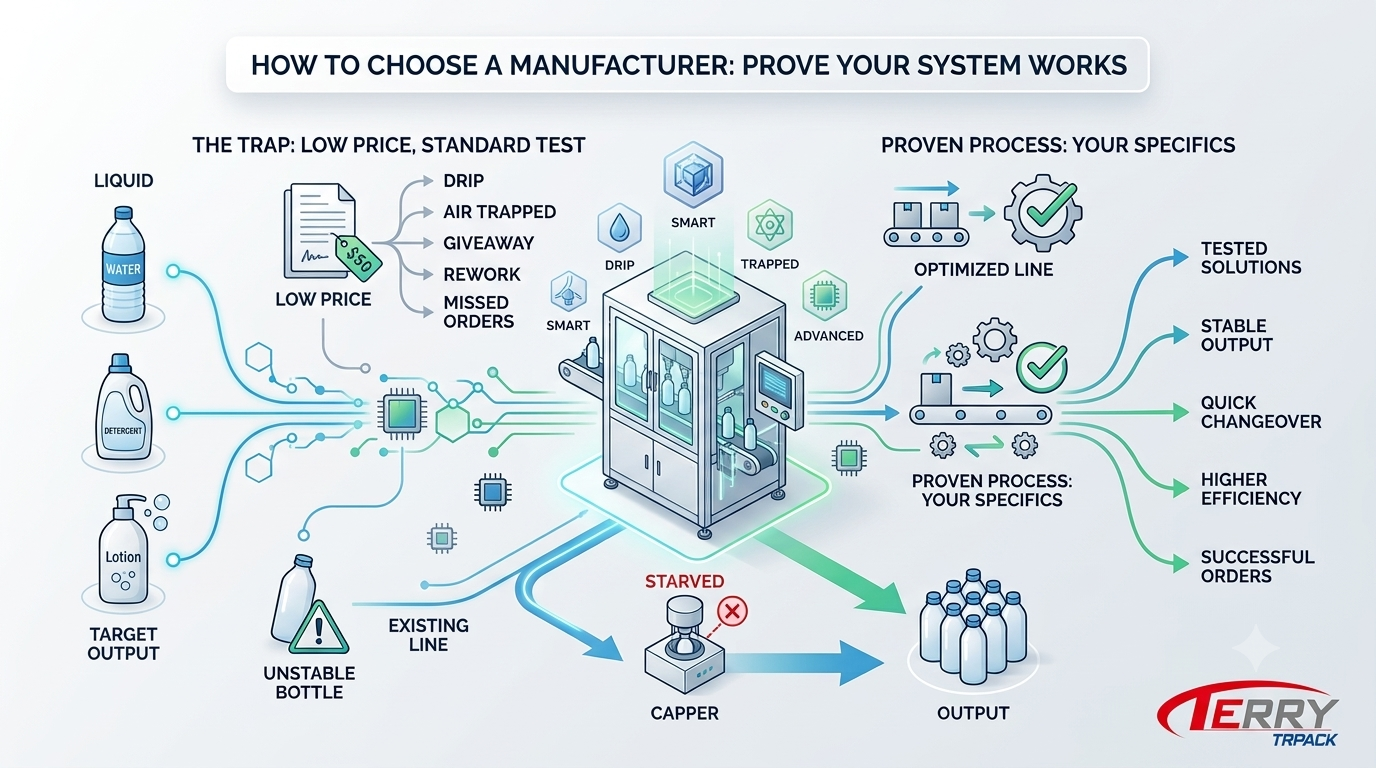
For example, if an automatic tube filler discharges finished tubes faster than the downstream cartoning machine can accept them, products may accumulate or the filling machine may need to stop.
The equipment layout should account for product transfer, discharge orientation, operator access, maintenance space, and potential bottlenecks.
Manufacturers should also consider whether the proposed system can be installed within the available factory space without obstructing normal operation or maintenance.
Production Line Synchronization and Control Interfaces
Production line integration requires more than connecting equipment with conveyors.
Machines may need to exchange signals relating to operating status, product availability, faults, emergency stops, and downstream readiness.
These connections help prevent one machine from continuing to discharge products when another machine cannot receive them.
A system integrator should evaluate the control architecture and determine how the equipment will respond during normal operation and unexpected interruptions.
For example, when downstream equipment stops, the upstream filling machine may need to pause according to an agreed control sequence.
Line balancing is equally important. The intended output should reflect the capabilities of the complete process rather than the maximum speed of a single machine.
Installation, Testing, and Project Acceptance
The responsibilities of a system integrator should be clarified before equipment manufacturing or installation begins.
A typical project discussion may cover equipment selection, technical drawings, interface requirements, installation, commissioning, operator training, and after-sales support.
Manufacturers should also establish appropriate acceptance criteria.
Factory Acceptance Testing (FAT) may be used to evaluate equipment functions before shipment, while Site Acceptance Testing (SAT) may assess performance after installation.
Depending on the project, agreed testing may include filling consistency, sealing performance, output, alarm functions, and communication between connected machines.
The exact scope of testing and installation support should be documented with the supplier rather than assumed to be included in every quotation.
How to Evaluate a Small Plastic Tube Filling Machine System Integrator
A capable system integrator should be able to explain why a proposed configuration fits the manufacturer’s application, not simply provide an equipment catalogue.
The evaluation process should focus on technical suitability, project responsibilities, and long-term operating requirements.
Verify Application Experience and Customization Capabilities
Different industries place different demands on tube filling equipment.
A system intended for cosmetic creams may require frequent specification changes, while an ointment packaging application may involve additional cleaning, documentation, or validation requirements.
Manufacturers should explain their product properties and packaging expectations, then assess whether the supplier can recommend a suitable configuration.
Requesting application-specific demonstrations, product trials, or relevant equipment references can provide a clearer understanding of the supplier’s capabilities.
Customization should address an identifiable production requirement rather than simply adding optional features.
Review Equipment Specifications and Integration Responsibilities
Equipment specifications provide an essential starting point, but they should be evaluated alongside the supplier’s integration responsibilities.
The following checklist can help procurement teams structure discussions with potential system integrators.
| Evaluation Area | Information to Confirm |
|---|---|
| Product compatibility | Viscosity, flow characteristics, product-contact materials |
| Tube specifications | Material, diameter, length, cap and tail design |
| Filling requirements | Filling range, accuracy, product handling |
| Sealing process | Method, appearance, strength and sample validation |
| Production capacity | Target output, operating conditions, changeover frequency |
| System integration | Feeding, discharge, coding, inspection and cartoning requirements |
| Control interfaces | Machine signals, interlocks, fault handling and coordination |
| Project delivery | Installation scope, FAT/SAT, documentation and training |
| After-sales support | Spare parts, maintenance assistance and technical response |
Before approving a proposal, manufacturers should confirm which components are included in the quotation and which will require separate procurement.
This helps avoid misunderstandings about the difference between machine supply and a complete integrated system.
Assess After-Sales Support and Long-Term Flexibility
Equipment performance must remain manageable after installation.
Manufacturers should evaluate spare-part availability, maintenance documentation, operator training, and the supplier’s ability to provide technical assistance.
It is also useful to consider future changes in product packaging.
If additional tube sizes, new formulations, or downstream equipment may be introduced, the supplier should explain how the proposed configuration could accommodate these changes.
A system that matches current production requirements while allowing practical modifications may offer greater operational flexibility over its service life.
Planning a Custom Plastic Tube Filling Solution with TRPACK
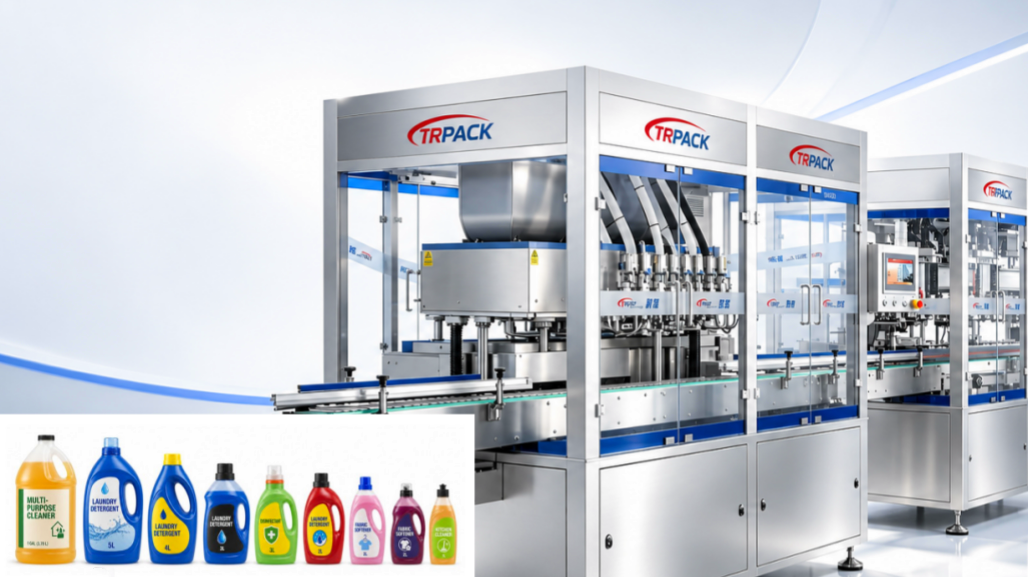
At TRPACK, tube filling equipment forms part of our broader filling and packaging machinery portfolio. We work with manufacturers across cosmetics, skincare, personal care, and related industries to evaluate equipment configurations according to their products and production requirements.
For plastic and aluminum-plastic laminated tube applications, the TRF-100 Fully Automatic Tube Filling and Sealing Machine is one equipment option worth considering.
The TRF-100 integrates tube supply, positioning, filling, hot-air tail sealing, trimming, and finished-product discharge. Its published specifications include a 2–400 ml filling range, compatibility with tube diameters of 13–50 mm, and a reference production capacity of 60 tubes per minute for a 50 ml product. Actual performance depends on the material, packaging specifications, and operating conditions.
For manufacturers working with multiple personal care formulations, our Hair Care & Body Care Filling and Capping Solutions provide a starting point for exploring broader packaging equipment requirements.
Our Cosmetic & Skin Care Filling and Packaging Solutions also cover equipment planning for products such as creams, lotions, cleansers, and other skincare formulations.
The suitability of a particular tube filling machine, together with any additional feeding, inspection, or packaging equipment, should be assessed against the customer’s actual production requirements.
Manufacturers can share their product characteristics, tube samples, target output, and available factory layout so that an appropriate equipment configuration can be discussed.
Find the Right Tube Filling System for Your Production Requirements
A suitable compact tube filling system should match the manufacturer’s actual production needs while allowing the filling, sealing, and downstream packaging processes to operate reliably together.
Before making a purchasing decision, consider not only the machine’s rated capacity but also its compatibility with your product, tube dimensions, cleaning requirements, available space, and potential expansion plans.
If you are evaluating a plastic tube filling machine or planning a customized packaging system, TRPACK can help discuss suitable equipment options based on your application.
Explore the TRF-100 Automatic Tube Filling and Sealing Machine or review our Cosmetic & Skin Care Packaging Solutions. Share your product information, tube specifications, expected capacity, and integration requirements with our team to discuss a customized equipment proposal.