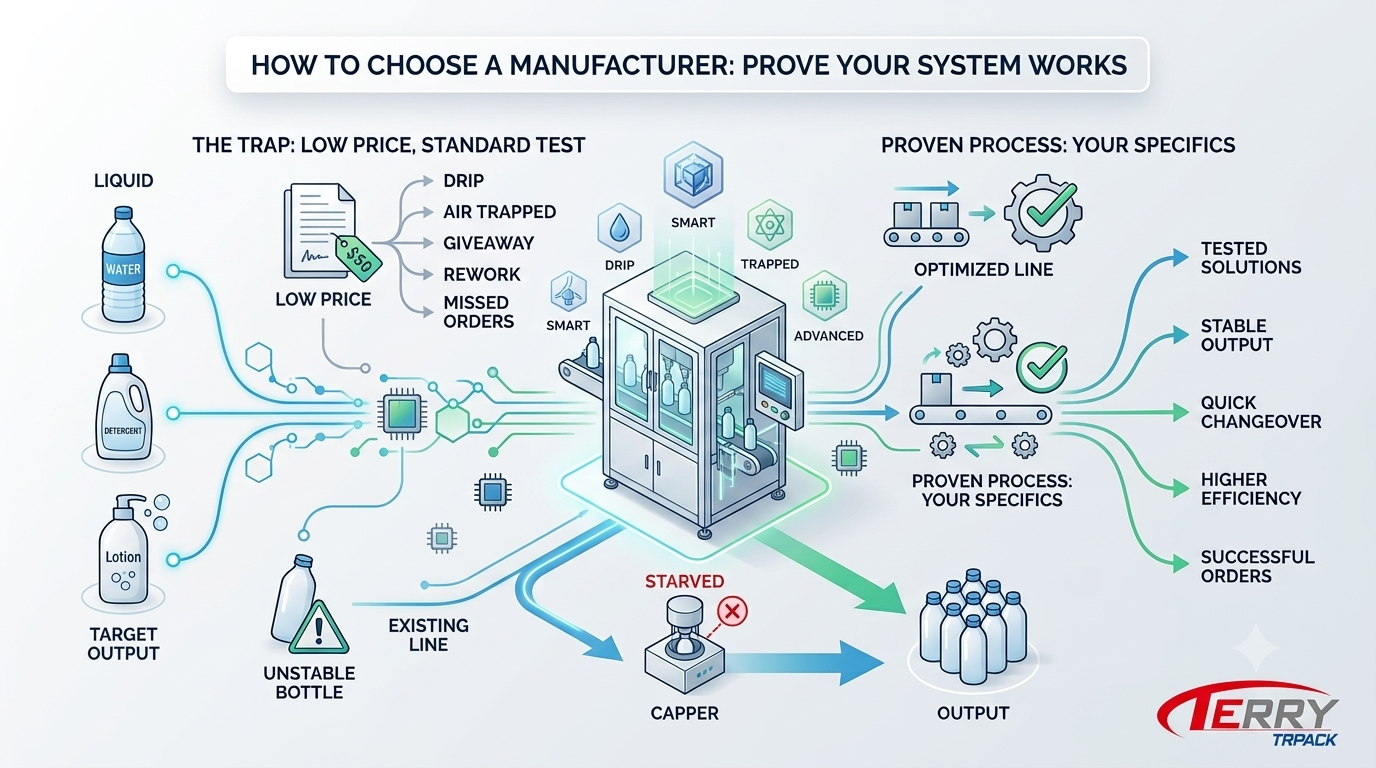
Choose the manufacturer that proves your liquid, bottle, target output, and existing line can run together—not the supplier that simply sends the lowest quotation. A machine may reach its advertised speed with water and one standard bottle, yet drip with your detergent, trap air in your lotion, struggle with an unstable container, or leave the capper starved downstream. Those problems rarely appear in the price column. They appear later as giveaway, rework, slow changeovers, missed orders, and frustrated operators.
That is why the decision must start with your process. A reliable automatic volumetric filling machine manufacturer asks detailed questions, tests representative samples, explains technical trade-offs, defines acceptance criteria, and takes responsibility for interfaces with upstream and downstream equipment. The purchase price matters, but production fit matters more.
What a Reliable Manufacturer Must Prove
A qualified supplier should show relevant application experience, material compatibility, repeatable filling performance, container-handling flexibility, line-integration capability, complete documentation, and a workable after-sales plan. Each point needs evidence. A polished brochure, a familiar PLC brand, or a factory video can support a decision, but none of them replaces a product test and a clear technical proposal.
- Experience with liquids that behave like yours, not just products from the same industry.
- A filling principle that matches viscosity, foam, particles, temperature, and cleaning needs.
- Accuracy and output data tied to defined products, volumes, bottles, and operating conditions.
- Stable handling of every current and planned container and closure format.
- Mechanical, electrical, and control interfaces that match the full production line.
- Documented testing, training, spare parts, manuals, safety functions, and service procedures.
- A total-cost case that accounts for waste, labor, changeovers, maintenance, and future expansion.
The right manufacturer does not sell you a machine first; it proves a process first.
When your application involves flowmeter-controlled dosing for free-flowing products, review this automatic volumetric liquid filling machine as a reference point, then ask the engineering team to confirm whether flowmeter, piston, pump, gravity, or weight-based control suits your material.
Define the Liquid Before You Compare Machines
Record How the Product Behaves
Start with a product data sheet that operators and engineers can use. Record viscosity at filling temperature, foaming, density, corrosiveness, volatility, particles, stringing, shear sensitivity, fill range, cleaning method, and product changes per shift.
These details change the design. A thin, non-foaming toner may suit a flowmeter or gravity system. A lotion may need a servo piston or suitable pump. Stringy gel may require a shut-off nozzle, while foaming cleaner may need bottom-up filling and controlled nozzle rise. Thick cream may need pressure-assisted feeding.
Viscosity can change with temperature, mixing, or storage. Ask the manufacturer to test the least favorable realistic condition. For multiple products, group formulas by flow behavior and cleaning risk to see whether one flexible machine can cover the range.
Compare Filling Principles by Product Risk
Servo piston filling meters a controlled volume and often suits products that range from moderate viscosity to thick creams. Check piston size, seal compatibility, cylinder cleaning, recipe repeatability, and whether product changeover requires tools. Pump-based volumetric filling offers flexible transfer and can suit oils, personal-care liquids, and selected viscous materials, but the pump type must match shear sensitivity, particles, and required flow stability.
Flowmeter filling measures flow directly and can simplify recipes for compatible free-flowing liquids. Verify conductivity or mass-flow requirements, calibration procedure, minimum flow range, product aeration, and cleaning access. Gravity filling works well for certain thin, non-foaming products when the tank head and valve design remain stable. Net-weight filling, meanwhile, measures mass rather than volume. It may help when density variation makes a volume target less useful, but it introduces scale response, vibration, and container-stability considerations.
The machine name never tells the full story. Ask why the manufacturer recommends a method, which risks it removes, and which compromises remain. A credible engineer can explain where the proposed system performs well and where another method may perform better.
Verify Bottles, Caps, and Changeovers as One System
List Every Format You Plan to Run
Prepare drawings or samples for every bottle, neck finish, cap, inner plug, pump, trigger, or spray closure. Include lightweight, unstable, soft, and irregular containers, plus formats planned for the next two or three years. The filler may dose accurately while the conveyor or capper creates the bottleneck.
Ask the supplier to list change parts, adjustment points, recipe settings, and changeover steps. A “universal” machine may still need guides, star wheels, neck locators, or cap-handling parts. Request a format matrix so nothing remains hidden.
Make Cleaning Part of the Buying Decision
Frequent product changes can consume more time than filling. Review nozzle removal, hose routing, tank access, dead legs, drain points, valve disassembly, and cross-contamination controls. Ask whether operators can clean in place or must dismantle parts.
For sensitive or regulated products, define the required hygienic standard before the supplier freezes the design. Quick-connect fittings, cleanable valves, stainless-steel contact parts, and smooth product paths support cleaning, but they do not automatically make every project compliant with GMP, FDA, pharmaceutical, food, or hazardous-area requirements. Your manufacturer should map the final machine specification to the standards, risk assessments, and documentation that apply at your site.
Evaluate the Factory Beyond Its Sales Presentation
Look for Engineering Evidence
Years in business matter less than the team’s ability to solve your application. Ask who reviews the product, designs the layout, writes the control sequence, and owns commissioning. Request drawings, utility data, a component schedule, control description, and changeover concept before approval.
TRPACK reports a 12,000-square-meter manufacturing base, more than 160 staff, a technical team of more than 40 people, and exports to more than 30 countries. Its company materials also cite more than 50 patents and software copyrights. These figures suggest in-house resources, but buyers should still judge the proposed machine against their own product test, layout, and acceptance criteria.
Confirm Materials and Chemical Compatibility
Ask the manufacturer to name every material that contacts the product: tank, tubing, valves, seals, pistons, nozzles, gaskets, and fittings. Stainless-steel grade alone does not settle compatibility. Seal compounds can swell, harden, or leach when exposed to solvents, oxidizers, fragrances, alcohol, bleach, or aggressive cleaners. The supplier should review the formula or safety data sheet and document the selected materials.
TRPACK states that its machines commonly use SUS304 for the main structure and SUS316L for product-contact parts. Its company profile also lists optional PP-coated frames and Teflon treatment for corrosive applications. Treat those options as starting points for an engineering review, not universal approvals for every chemical.
Demand a Realistic Factory Acceptance Test
A water test proves that valves open and conveyors move; it may not prove that your product runs. Whenever practical, send the actual liquid, bottles, and caps. Define sample quantity and safety requirements early.
Write acceptance criteria before the test. Measure fill consistency, giveaway, speed stability, dripping, foam, bottle handling, alarm response, stop-and-restart recovery, and changeover time. Record the product, volume, temperature, viscosity, duration, approved settings, and component configuration.
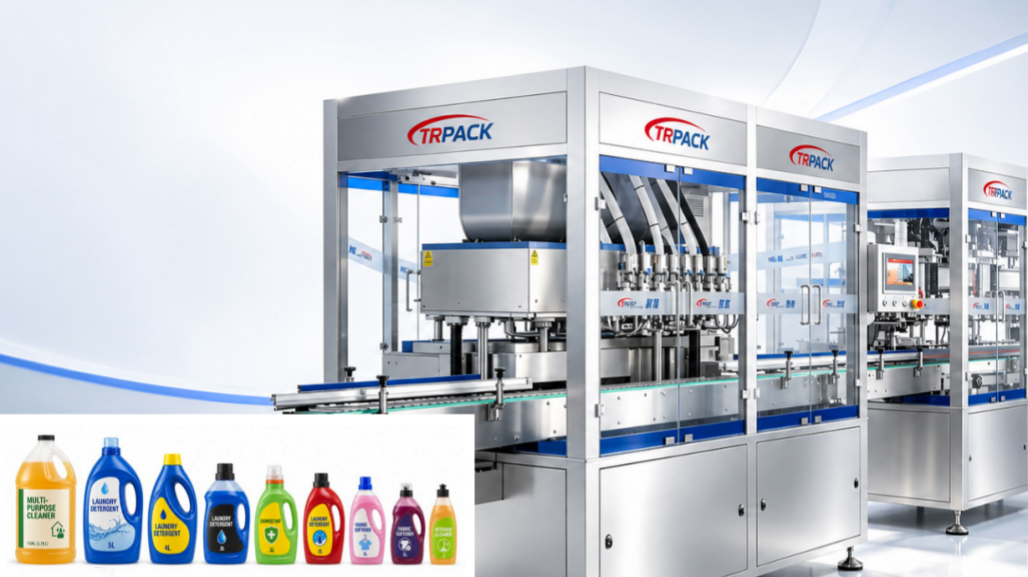
TRPACK’s current TR-CL page lists an eight-head system, fill ranges from 0.5 liter to 1 US gallon, and application-specific output and accuracy figures based on liquid as the test medium. It also describes mass-flowmeter measurement, optional submersion filling, quick-connect piping, external-seal nozzles, and online cleaning features. Use such published data to frame questions, not to predict your own result without a sample trial.
Review Documentation, Safety, and Service
Request electrical and pneumatic drawings, manuals, maintenance schedules, spare-parts lists, software backups, alarm lists, and training. Confirm emergency stops, guarding, interlocks, bottle and cap detection, reject handling, and restart behavior. Separate standard items, options, and site-validation duties.
TRPACK’s company information cites ISO 9001 and CE certification, while its service materials describe manuals, debugging videos, replacement parts, overseas support, and a 24-hour response channel. These capabilities can reduce communication friction, but the contract should still define response routes, warranty scope, remote-support access, technician travel terms, and the spare parts that ship with the machine.
Make the Filler Fit the Whole Production Line
Map the Process Before You Freeze the Layout
Draw the line from empty-bottle feeding to palletizing. Include every handling, filling, closing, inspection, labeling, and packing step. Mark accumulation points and places where bottles can tip, deform, leak, or queue.
A filler rated at 60 bottles per minute cannot create 60 saleable bottles per minute when the capper sustains 45, operators reload pumps manually, or the labeler stops after each bottle change. Ask the system integrator to balance practical speeds, buffer capacity, reject logic, and recovery sequences across the line. The goal is stable saleable output, not one impressive nameplate number.
Confirm Mechanical and Control Interfaces
Check conveyor height, direction, speed range, bottle pitch, floor loading, utilities, and service clearance. Define PLC communication, hardwired signals, emergency-stop zones, sensor handshakes, batch data, recipe ownership, reject confirmation, and remote-access rules.
When several suppliers provide separate machines, assign one party to own the interface list and line test. Without that responsibility, each vendor can claim that its station works alone while the connected line keeps stopping. A turnkey solution provider can reduce this risk when it controls bottle unscrambling, filling, capping, labeling, case packing, and palletizing under one engineering plan.
TRPACK positions itself as a one-stop system integrator for individual machines and complete automated lines. Its current product structure covers start-of-line equipment, Automatic Filling Machine options, capping, labeling, inspection, cartoning, case packing, and palletizing. That breadth can simplify responsibility, although the project team must still verify every interface with existing equipment.
Design for the Formats You Have Not Launched Yet
Futureproofing does not mean buying the largest machine. It means leaving sensible options. Discuss additional filling heads, larger pumps, new bottle guides, future cap feeders, inspection cameras, faster conveyors, coding systems, and downstream automation. Reserve panel space, network capacity, floor area, and mechanical attachment points when the cost remains modest.
A modular design may let you add capacity without replacing the full line, but only when the original structure, controls, and product supply can support the upgrade. Ask the manufacturer to state what expansion remains practical and what would require a new machine.
Compare Total Cost, Not Quotation Price
The purchase price represents only one part of the project. Add freight, site preparation, installation, training, change parts, validation, maintenance, spares, utilities, cleaning labor, product left in the system, and downtime. Also estimate the cost of weak support during a busy order cycle.
Use your own production records to calculate annual benefit:
Annual Automation Benefit = Labor Savings + Reduced Product Loss + Increased Saleable Output + Reduced Rework − Annual Operating and Maintenance Costs
Estimated Payback Period = Total Project Investment ÷ Annual Automation Benefit
Do not accept a guaranteed payback claim unless the supplier uses your verified labor rates, product costs, production schedule, reject rate, downtime, and demand forecast. Automation creates value only when the line sells more acceptable product or reduces a real operating cost.
| Evaluation Category | Suggested Weight | Evidence to Request | Buyer Check |
|---|---|---|---|
| Product and filling compatibility | 25% | Sample test, material review, technical proposal | Does the evidence match the actual formula and fill range? |
| Engineering and line integration | 20% | Layout, interface list, control sequence | Who owns performance of the connected line? |
| Quality, safety, and documentation | 15% | Certificates, drawings, manuals, inspection records | Which project-specific standards remain open? |
| Changeover and scalability | 15% | Format matrix, recipe plan, expansion options | Are hidden change parts or long adjustments likely? |
| After-sales support | 15% | Training, spare-parts plan, response procedure | Can operators reach qualified technical help quickly? |
| Total cost of ownership | 10% | Complete commercial scope and utility data | What costs sit outside the headline quotation? |
Score each supplier from one to five, multiply by the weight, and record the reason for every score. This method does not remove judgment. It makes judgment visible, so procurement, operations, engineering, and quality teams can challenge assumptions before the purchase order.
Warning Signs During a Factory Audit
Walk away from vague confidence. A weak supplier often recommends a model before asking about viscosity, bottle stability, cap type, cleaning, or target output. It quotes speed without naming the product, volume, and test conditions. It calls every interface “standard,” avoids material compatibility questions, or refuses to define a factory acceptance test.
Commercial warning signs matter just as much. Watch for missing change parts, unclear spare-parts scope, training that depends on one salesperson, warranty terms without response procedures, or absolute claims about accuracy, compliance, and payback. A professional manufacturer should welcome precise questions because precision protects both parties.
During a visit or video audit, inspect machines in assembly, product-contact parts, panels, test records, manuals, and a live FAT. Ask an engineer to explain nozzle control, calibration, indexing, alarm recovery, and changeover, then compare the answer with the proposal.
Why TRPACK Fits Customized and Turnkey Projects
TRPACK focuses on filling and packaging equipment for cosmetics, skin care, personal care, household cleaning, oral hygiene, and healthcare products. The company combines filling machines with bottle handling, capping, labeling, inspection, case packing, and palletizing, which suits buyers who want one provider to coordinate a complete line.
Its company profile highlights servo-driven control, intelligent monitoring, modular changeovers, handling for round, flat, square, and irregular bottles, and compatibility with pump, spray, and tamper-evident closures. It also describes configurations for free-flowing liquids, foaming products, and high-viscosity creams or pastes up to 120,000 cPs. Those capabilities support a broad application range, but the engineering team should confirm each formula, container, closure, and required standard before order approval.
Buyers who need a broader comparison can review the full Filling Machine range, then submit the product name, viscosity, density, safety data, fill volume, bottle drawing, closure sample, required speed, available layout, destination country, and preferred automation scope. That information gives the manufacturer enough context to recommend a realistic system rather than a generic model.
Questions Buyers Ask Before Ordering
What information should I prepare before contacting a manufacturer?
Prepare the product name, viscosity, density, temperature, foaming and corrosion behavior, fill range, bottle and cap samples, target output, cleaning method, utilities, layout, and destination country. Add future formats for changeover and expansion planning.
Which volumetric method suits high-viscosity creams and pastes?
Servo piston filling often provides controlled dosing for thick products, while suitable pumps may also work. The best choice depends on viscosity, air entrapment, particles, temperature, shear sensitivity, and cleaning. Ask the manufacturer to test the actual product and explain the feed pressure, nozzle, seals, and product path.
How can I verify filling accuracy before purchasing?
Define an FAT with your product, container, volume, temperature, and speed. Sample every head, record average fill and variation, inspect dripping and foam, and repeat after a stop and restart. Put limits in the contract.
Can a new filler connect with my existing conveyor and capper?
Yes, when suppliers confirm conveyor height, bottle pitch, speed, accumulation, sensor handshakes, emergency stops, reject logic, and control ownership. Require a written interface list and connected-line test.
What product-contact materials suit corrosive cleaners?
The answer depends on the chemical, concentration, temperature, and cleaning agent. Review stainless-steel grades, plastics, coatings, hose materials, and every seal compound against the safety data sheet. PP protection or PTFE components may help in some applications, but only a documented compatibility review can support the final selection.
How should I compare quotations from different suppliers?
Normalize the scope: heads, tanks, pumps, conveyors, guarding, change parts, controls, documentation, FAT, training, commissioning, spares, freight, and warranty. Then weight product fit and integration above headline price.
What should a filling-machine FAT include?
The FAT should verify fill consistency, practical output, bottle handling, dripping, foaming, downstream handoff, alarms, interlocks, restart recovery, cleaning access, and changeover. Record samples, settings, conditions, deviations, and corrections.
How long should bottle-format changeover take?
No universal time applies. Changeover depends on bottle shape, cap system, product path, change parts, cleaning, and operator skill. Ask the supplier to demonstrate the full process during FAT with your formats and to separate mechanical adjustment time from product-cleaning time.
Which spare parts should ship with a new machine?
Prioritize items that can stop production: seals, gaskets, nozzles, sensors, valves, fuses, relays, pneumatic components, and format parts. Request one-year and two-year quantities, part numbers, lead times, and storage guidance.
How do I calculate total cost of ownership?
Add purchase, freight, duties, utilities, installation, validation, training, change parts, maintenance, spares, cleaning time, product loss, and expected downtime. Subtract verified labor savings, lower giveaway, reduced rework, and extra saleable output. Compare suppliers over the same useful-life period.
Which certifications and documents should the manufacturer provide?
Request certificates relevant to the supplier and project, plus electrical drawings, component lists, manuals, risk documentation, test records, spare-parts lists, software backups, and material declarations. CE or ISO credentials do not replace the buyer’s site-specific compliance review or validation responsibilities.
How can I tell whether the machine can scale later?
Ask which filling heads, pumps, conveyors, cap systems, inspection devices, and downstream modules can be added. Confirm spare PLC capacity, panel space, network ports, floor space, product-supply capacity, and structural limits. Require the supplier to distinguish simple upgrades from changes that need a new machine.
Choose the Partner Who Can Prove the Process
A good automatic volumetric filling machine manufacturer turns uncertainty into testable decisions. It matches the filling principle to the liquid, controls bottles and caps as one process, documents interfaces, tests real products, and supports the line after installation. That discipline protects output, product quality, labor planning, and future expansion far better than a low quotation alone.
Your next step is practical: send TRPACK your product sample or data sheet, bottle and closure drawings, fill range, required output, available layout, and current line details. Ask for a project-specific recommendation, a proposed test plan, and a complete scope that separates standard equipment, options, change parts, and services.